Writer: Nilsson AndersRelease Time: 2026-11-25 08:19Browse: 53
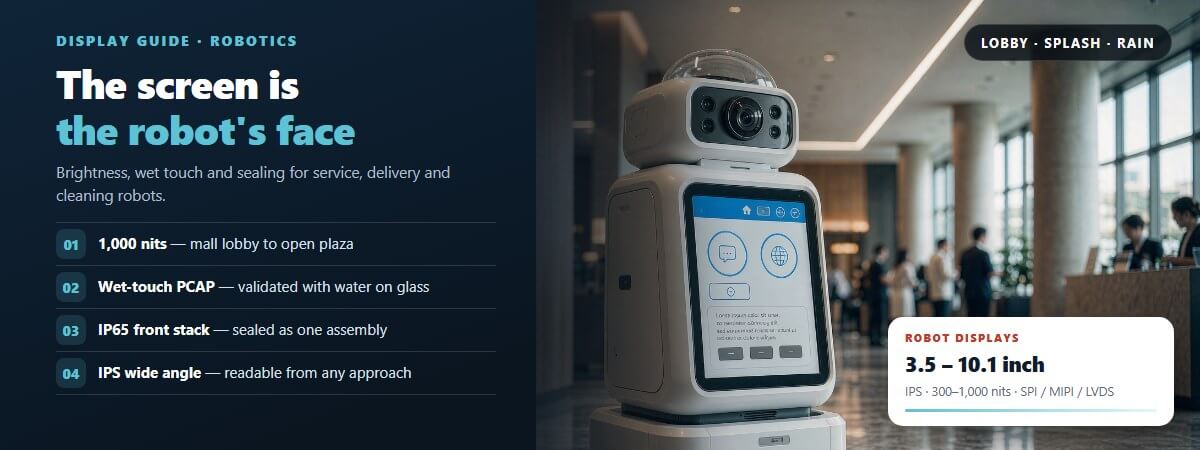
A hotel guest taps a welcome screen in the lobby; a cleaner sets a scrubbing route on a machine that is simultaneously spraying water at its own front panel; a delivery robot rolls out of an air-conditioned mall into August sunlight. Three very different screens, one product category — and the display choices that work for one will fail for another.
This guide splits robots into the three families that matter for display selection — service, delivery and cleaning — and works through what each actually demands: brightness against changing light, touch that survives wet and gloved hands, IP sealing that belongs to the enclosure rather than the panel, and the interface decision that ties the module to the control board. For the industrial fixed-installation counterpart of the same decision process, see the guide to HMI displays in automation.
Contents
Where the robot operates and who touches the screen decide the display spec — before any datasheet is opened.
Hotels, restaurants, hospitals, malls. The screen is the face of the product: welcome messages, navigation, service menus, order details. It has to look good at arm's length, respond instantly to a guest's finger, and hold readable contrast through a full working day. Presentation quality is a sales argument here — a poorly integrated screen undermines the whole product. In hospital deployments, display hygiene and reliability expectations are closer to the requirements described in the healthcare display guide.
Meals, parcels and supplies moving between floors, buildings, campuses — sometimes outdoors. The display must stay readable as ambient light swings from mall interior to open plaza, accept order confirmations from users who may have just come in from the rain, and survive movement-induced vibration. Outdoor routes push brightness and optical treatment up the priority list.
The harshest environment of the three: water splashes, cleaning chemicals, dust, continuous motor vibration — and an operator configuring modes and reading error messages on the same panel. Touch reliability through a wet surface, material compatibility with cleaning agents, and sealing design dominate the selection here.
Size follows from what the screen is asked to do: a status readout can stay small; anything with menus, maps or customer interaction needs real estate. Common design practice:
| Robot Type | Common Size Range | Typical Display Functions |
|---|---|---|
| Compact service robot | 3.5–5 inch | Status, basic menus, user prompts |
| Interactive service robot | 5–10.1 inch | Navigation, service menus, customer interaction |
| Delivery robot | 4.3–10.1 inch | Delivery status, instructions, order information |
| Commercial cleaning robot | 4.3–7 inch | Cleaning settings, status, maintenance menus |
| Industrial cleaning robot | 7–10.1 inch or larger | Detailed controls, system info, diagnostics |
Resolution should serve the interface, not chase a number. A status UI is fine at moderate resolution; maps, video feeds and dense menus justify more pixels — if the mainboard can drive them. Then design the UI for the real viewing distance: text size, icon dimensions, touch-target spacing, orientation and scaling. A high-resolution panel with 8-pixel touch targets is a worse product than a modest panel laid out for the distance users actually stand at. The PPI-versus-usable-UI trade-off is worked through in detail in the handheld gaming and wearables guide.
Any robot that crosses a doorway inherits the weather. A screen tuned for lobby lighting turns into a mirror at the entrance. Reference ranges:
| Brightness | Potential Application |
|---|---|
| 300–500 nits | Indoor service robots, controlled lighting |
| 500–800 nits | Bright indoor and semi-outdoor use |
| 800–1,000 nits | Outdoor delivery robots, bright environments |
| 1,000+ nits | Specialized sunlight-readable applications |
Reflections matter as much as raw brightness. Anti-glare treatment tames surrounding light sources; anti-reflection coatings help further; optical bonding removes the internal air-gap reflection and buys back real outdoor contrast — at the cost of process control and repair considerations. Weigh ambient conditions, cover glass material, brightness, touch structure and manufacturing process together. The physics behind these choices is covered in the high-brightness drone display guide and the note on adjusting LCD brightness; for what 800 nits looks like in a compact format, see the 2-inch 800-nit AMOLED with on-cell touch.
Touch is how users select functions, confirm deliveries and configure cleaning routes. For service and delivery robots, projected capacitive (PCAP) is the default: responsive finger input, multi-touch, smooth glass, clean optical clarity — a smartphone-like experience guests already know how to use. See the touch screen product line for integration-ready examples such as the 4.2-inch TFT LCD with capacitive touch.
Resistive touch still has a place where stylus or pressure-based input is preferred; its optical and interaction characteristics differ, and the choice should follow actual operating requirements — the 4.4-inch module with 4-wire resistive touch shows the construction.
This is where robot touch differs from consumer touch. Water on the surface, cleaning residues, moisture and grounding conditions all confuse a standard capacitive controller: false touches, dead zones, phantom inputs. Validate wet-touch behavior, glove operation (if any), sensitivity and false-touch rejection with the actual cover lens and enclosure of the final product — never assume a standard PCAP panel handles a wet surface reliably just because the datasheet says "capacitive."
| Comparison | TFT LCD | AMOLED |
|---|---|---|
| Light generation | Backlight | Self-emissive pixels |
| Brightness | High-brightness configurations available | Depends on panel design and operating conditions |
| Black level | Set by LCD structure and backlight | Pixels switch fully off |
| Power | Backlight-dominated | Content- and brightness-dependent |
| Product options | Wide range of sizes and configurations | Selected sizes and resolutions |
| Application focus | General-purpose and industrial robots | Contrast- and slimness-prioritized designs |
Choose TFT LCD as the starting point for most robots: the widest size and touch configuration range, interfaces that map onto robot mainboards, IPS variants for off-axis readability (TFT LCD overview), and high-brightness options for outdoor delivery routes.
Consider AMOLED when deep blacks, contrast or a slim structure are product-defining — a premium service robot's face, for example. Validate sustained brightness, power behavior and thermal conditions first; the OLED display family includes modules such as the 6.39-inch 1080×2340 AMOLED with capacitive touch suited to interactive robots.
Robot screens live at awkward heights and angles: a service robot's face at guest height, a cleaning robot's tilted control panel viewed by a standing operator, a delivery robot's side-mounted status screen. Wide viewing angles keep the interface readable without standing square in front of the robot — which, for a moving machine, is not always possible or safe.
IPS TFT panel options hold contrast and color across wide left-right and up-down cones. Evaluate horizontal and vertical angles, contrast and color shift at off-axis positions, orientation, installation height and tilt — and test in the real mounting position, not flat on a bench. A screen that measures perfectly horizontally can wash out when tilted 30 degrees upward on the robot's chest.
Cleaning robots meet water splashes and detergent mist; outdoor delivery robots meet rain. IP codes describe the tested enclosure — IP65 means dust-tight and protected against water jets, for the assembly that was tested. A robot rated IP65 earned it through its front cover, adhesive, housing, connectors, cable entries and sealing. The LCD module and touchscreen inside do not inherit the rating. Design the sealing around the module and verify on the finished robot.
The front surface takes the abuse: contact, scratches, fingerprints, chemicals. Consider glass thickness, scratch resistance, anti-glare and anti-fingerprint coatings, edge sealing, chemical compatibility, and touch performance through the stack. For cleaning robots, chemical compatibility is the quiet killer — cleaning agents slowly attack coatings, adhesives and plastics. Test the actual materials against the actual cleaning products, over time, not in a single wipe test.
Mobile robots vibrate continuously — floors, ramps, wheels, brushes, motors. The display module, FPC, connectors and mounting structure must tolerate that together. Test the complete assembly; a panel that survives a bench shake table can still work loose through a bracket resonance the bench never reproduced.
A mall robot sees stable indoor temperatures; a delivery robot sees summer and winter; a cleaning machine works a cold warehouse at 6 a.m. and a heated lobby at noon. Confirm operating and storage ranges, low-temperature LCD response, backlight behavior, touch controller limits, thermal management, and expected daily operating hours. Low temperatures slow liquid-crystal response; high temperatures shorten backlight life.
For robots designed to run for years, add supply-side items: long-term module availability, backlight lifetime specification and maintenance expectations. Extended-range modules exist — see wide-temperature display options, including the 7-inch high-brightness wide-temperature AMOLED.
Battery-powered robots spend real energy on the display. The backlight dominates LCD consumption — every brightness step costs runtime — while AMOLED consumption tracks content. Review typical and maximum power, voltage and current, backlight driver requirements, dimming range, standby power, thermal behavior, and battery capacity against expected operating time.
| Interface | Typical Characteristics | Design Considerations |
|---|---|---|
| SPI | Simple serial communication | Suits certain low-resolution displays |
| RGB | Parallel pixel data transmission | Compatible timing and signal routing required |
| MIPI DSI | High-speed serial interface | Requires a compatible controller and mainboard |
| LVDS | Differential signal transmission | Used in larger embedded display systems |
| eDP | High-speed embedded display interface | Requires a compatible system architecture |
Compact service robots usually land on SPI, RGB or MIPI DSI; larger industrial machines lean toward LVDS or eDP when the mainboard supports them. Before finalizing the module, confirm pin definitions, connector types, FPC dimensions, signal timing and power requirements against the control board; the LCD controller board lineup covers most bridge combinations.
| Selection Item | Questions to Confirm |
|---|---|
| Robot type | Service, delivery or cleaning robot? |
| Screen size | Compact status screen or larger touchscreen? |
| Resolution | How much information must be on screen? |
| Brightness | Indoor, semi-outdoor or outdoor routes? |
| Touch type | Capacitive or resistive? |
| Wet-touch | Wet hands, splashes, cleaning residues? |
| Viewing angle | What is the actual mounting height and tilt? |
| Protection | What enclosure-level IP rating is required? |
| Cover glass | Scratch, chemical or anti-fingerprint needs? |
| Temperature | Operating and storage ranges expected? |
| Power | Does the display fit the battery budget? |
| Interface | Compatible with the robot's mainboard? |
| Mechanical | Module dimensions and FPC positions suitable? |
Answering these before the prototype build is cheap; answering them after the enclosure is tooled is not.
Standard modules rarely land exactly on a robot's enclosure, battery and interface constraints. Youritech provides LCD and touch display solutions for industrial and consumer applications — see the custom LCD and OLED service and solutions by application.
For robot projects, customization typically covers:
Evaluate the display together with the control board, enclosure, power system and operating environment. If you are developing a service robot, autonomous delivery robot or commercial cleaning machine, contact Youritech to discuss your requirements.
Request a Quote / Get a Custom Display Solution
TFT LCD is the common choice — it offers the widest range of sizes, resolutions, touch configurations and interfaces. IPS TFT LCD is worth specifying when the screen must stay readable from off-axis positions.
300–500 nits can suffice indoors; outdoor routes usually need 800–1,000 nits or more. Anti-glare treatment and optical bonding improve visibility further and often matter more than raw brightness.
Yes — but wet-touch performance, false-touch behavior, cover glass and controller configuration must be tested under real operating conditions, with water on the surface and the actual cleaning agents involved.
No. IP65 applies to the tested enclosure or assembly. The front panel, housing, connectors and sealing structure achieve the rating as a system; a standalone LCD module carries no such guarantee.
TFT LCD is usually the practical option — flexible configurations and high-brightness choices for outdoor routes. AMOLED suits designs that prioritize deep blacks, contrast or a slim structure. Decide by operating conditions, power budget and product design.
SPI, RGB and MIPI DSI cover most compact systems; larger embedded systems may use LVDS or eDP. Match the interface to the display module and the robot's mainboard architecture early in hardware design.
Yes. Dimensions, resolution, brightness, touch integration, cover glass, FPC layout and internal interfaces can all be customized subject to technical feasibility.
Robot display selection is a balance of readability, touch behavior, environmental durability, power and hardware fit. Service robots live or die by interaction quality; delivery robots by changing light and mobile reliability; cleaning robots by sealing, chemical compatibility and long-term endurance. Define the robot's environment and requirements early, and the display becomes an asset instead of a warranty claim.


