Writer: adminRelease Time: 2026-08-19 06:00Browse: 287
LCD display technology continues to play an important role in modern electronic products. While OLED and other emerging display technologies are receiving increasing attention, TFT LCD remains a practical choice for many industrial, automotive, medical, transportation, energy and embedded applications.
In 2026, the focus is no longer simply on screen resolution or display size. Manufacturers are looking for LCD displays that can deliver better visibility, wider operating temperature ranges, lower power consumption, reliable long-term operation and easier integration with existing hardware.
For product designers and engineers, understanding these trends can make it easier to select the right LCD display for a new project.
One of the biggest changes in the display market is the move away from a one-size-fits-all approach.
A standard consumer LCD may work well in an office or indoor environment, but industrial and automotive equipment often requires very different specifications. A display installed inside an EV charger, for example, may need high brightness, capacitive touch and reliable operation across a wide temperature range. A display used in aerospace or industrial equipment may place greater emphasis on reliability, viewing angle and long-term availability.
As a result, LCD display selection is increasingly driven by the application rather than by screen size alone.
Common requirements now include:
This trend is particularly important for industrial display manufacturers because the display has become part of the overall system rather than simply a visual output device.
Brightness has become one of the most important specifications for LCD displays used outside.
A conventional indoor display may provide sufficient visibility at several hundred nits. However, direct sunlight can make a standard display difficult to read. High-brightness LCD panels with 800, 1000, 1500 nits or even higher brightness are increasingly being used in equipment that operates outdoors or near windows.
Applications include:
However, high brightness alone does not guarantee good sunlight readability.
Display designers also need to consider contrast ratio, surface treatment, viewing angle, optical bonding and reflected ambient light. An anti-glare surface, for example, can reduce distracting reflections, while optical bonding can improve optical performance by reducing the air gap between display components.
YOURITECH's LCD portfolio includes high-brightness displays designed for applications such as EV chargers, automotive systems and aerospace equipment, including models with brightness levels from around 1000 nits to 2000 nits and beyond.
Temperature is another critical consideration for professional display applications.
Industrial machines, vehicles, outdoor equipment and aerospace systems may experience much larger temperature changes than consumer electronics. A display that works reliably in an office environment may not perform equally well in a machine operating outdoors.
For these applications, wide-temperature LCD displays are designed to operate across extended temperature ranges such as:
The required range depends on the equipment and installation environment.
Automotive applications are a good example. Displays inside vehicles can be exposed to both very low and very high temperatures. Industrial equipment may also operate continuously in factories, warehouses or outdoor locations where environmental conditions are difficult to control.
For this reason, wide temperature LCD display has become an important specification when engineers select a panel for long-term commercial or industrial use.
Automotive displays are another major area of development in 2026.
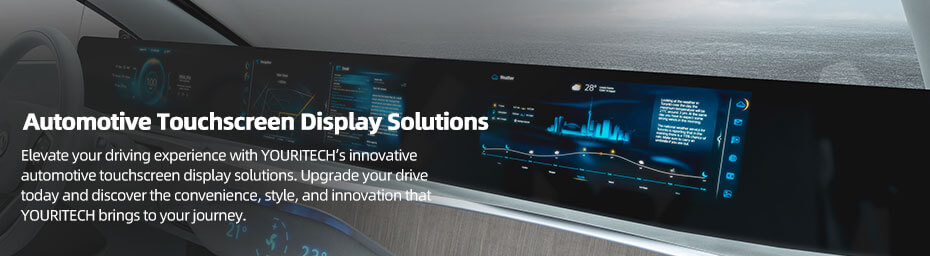
Modern vehicles increasingly use displays for instrument clusters, center information displays, passenger entertainment, rear-seat systems and other human-machine interfaces. This creates demand for larger screen sizes, higher resolutions, wider viewing angles and improved brightness.
At the same time, automotive LCD displays need to meet demanding environmental requirements.
Typical requirements include:
YOURITECH's recent automotive display portfolio illustrates this trend, with 7-inch, 9-inch and 10.1-inch TFT LCD solutions offering combinations of IPS panels, high brightness and wide-temperature operation. Some listed automotive models reach 1200–1400 nits or higher.
For automotive designers, the challenge is not simply finding a larger screen. The display needs to match the vehicle's mechanical space, electronics architecture, thermal environment and user interface requirements.
IPS LCD technology continues to be widely used where viewing angle and image consistency are important.
Compared with traditional narrow-viewing-angle LCD solutions, IPS panels can provide more consistent image quality when the user views the screen from different directions. This is particularly useful for industrial control panels, medical equipment, automotive displays and other applications where multiple users may view the same screen.
In professional applications, engineers typically evaluate several factors together:
Viewing angle + brightness + contrast + resolution + temperature + interface
Choosing an LCD based on only one parameter can result in an unsuitable display.
For example, a 1200-nit panel may appear attractive for an outdoor application, but if the viewing angle, mechanical dimensions or interface do not match the system, it may still require significant redesign work.
Higher resolution continues to be an important display trend, but more pixels do not automatically mean a better solution.
For industrial equipment, the correct resolution depends on:
A 7-inch industrial control panel may not need the same resolution as a 15.6-inch high-end visualization system.
For applications requiring detailed images, maps, video or complex interfaces, Full HD, 2K and 4K LCD displays can provide clear advantages. For simple machine interfaces, however, a lower resolution may provide a better balance between performance and cost.
The goal is to select the right resolution, not necessarily the highest resolution available.
Modern equipment increasingly combines display and touch functions into a single human-machine interface.
Capacitive touch is particularly common in applications where users expect smartphone-like interaction. Industrial systems may also use touchscreens with gloves, protective covers or customized interfaces depending on the working environment.
A complete LCD touch solution may include:
This creates another important trend: display suppliers are increasingly expected to provide more than a bare LCD panel.
Instead of purchasing individual components from several suppliers, equipment manufacturers may prefer a complete display and touch solution that has already been evaluated for compatibility.
Display interfaces are also becoming increasingly important during product development.
Depending on the application, LCD displays may use:
The interface affects system architecture, cable design, bandwidth, controller selection and PCB development.
For example, MIPI is widely used in compact embedded devices, while LVDS remains common in industrial and automotive display systems. eDP is frequently selected for higher-resolution displays and computer-related applications.
Before selecting a display, engineers should confirm both the electrical interface and the mechanical requirements.
A display that matches the resolution but uses an incompatible interface may still require an additional controller board or a redesign of the main PCB.
Standard displays remain useful for many projects, but some applications require customized solutions.
Common customization requirements include:
This is particularly relevant for equipment manufacturers with limited installation space.
For example, a stretched bar LCD can be a better solution than a conventional 16:9 display when the available space is long and narrow. YOURITECH's product portfolio includes stretched bar LCD displays as well as standard TFT LCD modules, supporting applications such as transportation, retail and industrial equipment.
OLED offers several advantages, including self-emissive pixels, deep blacks and high contrast. However, LCD remains highly competitive in many industrial and commercial applications.
LCD continues to offer several practical advantages:
For applications that require continuous operation, high brightness or long product life, LCD can still be a very attractive option.
The decision between LCD and OLED should therefore be based on the application rather than simply choosing the newest display technology.
Before selecting an LCD display, product designers should evaluate the complete operating environment.
Choose the screen size based on available installation space and viewing distance.
Select the resolution according to image content, processor capability and required visual detail.
For outdoor applications, consider high-brightness and sunlight-readable LCD solutions rather than relying on standard indoor brightness.
IPS and other wide-viewing-angle technologies are useful when users may view the display from different directions.
Make sure the LCD's operating temperature range matches the actual environment of the finished product.
Confirm compatibility with the system's MIPI, LVDS, eDP, RGB, TTL or HDMI interface.
Determine whether the project requires PCAP, resistive touch or no touch function.
Check the active area, outline dimensions, thickness, mounting structure and FPC position before finalizing the display.
For industrial equipment, display availability can be just as important as the initial specification. A stable supply can help reduce redesign and qualification costs over the product's lifetime.
The LCD market is not standing still.
Instead, LCD technology is developing toward more specialized and application-oriented solutions. High brightness, wide temperature operation, higher resolution, improved optical performance, touch integration and customized mechanical designs are becoming increasingly important.
At the same time, technologies such as Mini-LED backlighting are pushing LCD performance further, particularly in applications where higher contrast, improved local dimming and high brightness are required.
For equipment manufacturers, the key question in 2026 is not simply whether LCD is still relevant.
The more useful question is:
Which LCD technology and specification best fit the actual application?
A well-designed LCD solution can provide the right combination of visibility, reliability, integration flexibility and cost for industrial and commercial products.
Selecting the right display supplier can make a significant difference during product development.
YOURITECH provides TFT LCD, OLED, touch panel, cover lens, bonding and customized display solutions for a wide range of industries. Its portfolio covers applications including automotive, energy and industrial equipment, healthcare, transportation, defense and aerospace, retail technology and other embedded systems.
From standard LCD modules to customized display solutions, the selection process should begin with the actual requirements of the finished product.
If you are developing a new industrial machine, automotive system, EV charger, medical device or other embedded product, choosing the right LCD specification early can help reduce development time and avoid unnecessary hardware changes.
Looking for a high-brightness, wide-temperature or customized LCD display? Explore YOURITECH's LCD display solutions or contact the engineering team to discuss your project requirements.


