Writer: Andrew MartinRelease Time: 2026-11-05 07:00Browse: 12
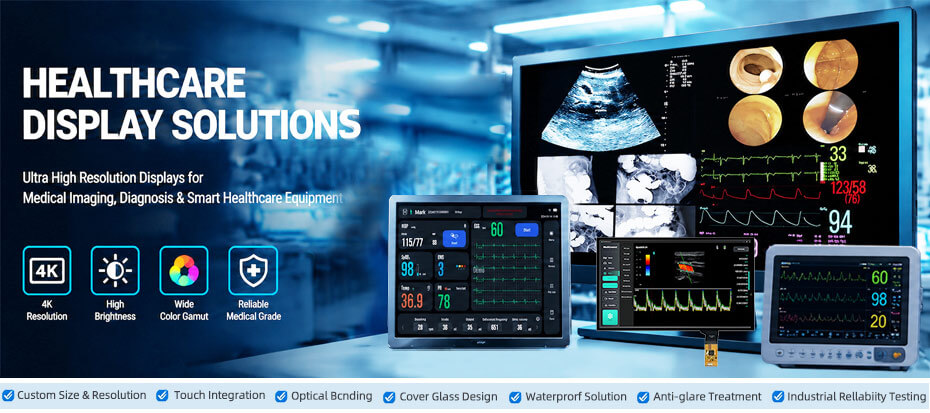
A patient monitor in an ICU holds the same layout for eighteen hours a day. An endoscope tower shows a moving colour image for forty minutes at a stretch. A handheld meter shows four digits and goes back to sleep. Three devices, one question — LCD or OLED — and three different answers.
This comparison is written from the side of the table where someone has to sign off the bill of materials and live with the decision for five years. That means less time on contrast ratios measured in a dark room, and more on brightness in a lit ward, static images on a screen that never sleeps, and whether the panel will still be buyable in year three.
Contents
For most medical equipment, TFT LCD is the safer choice: a wider size range, more interface options, brightness headroom when the device sits near a window, no pixel-aging mechanism, and supply that lasts. OLED wins where the product needs a thin module, a genuinely black background, or a high-resolution colour panel in a size that LCD makes clumsy.
Translated into the two lists people actually want:
Choose LCD when the screen is on all day, the interface is mostly light background with fixed labels, the device must be readable in daylight, or you need a 5 to 15 inch panel that stays available for five years.
Choose OLED when the module thickness is constrained, the interface is dark and mostly static-free, the application is a small status display drawing almost nothing at idle, or the product needs phone-class resolution in a hand-held form factor.
A TFT LCD is a shutter in front of a lamp. The liquid crystal layer decides how much backlight reaches each subpixel, and the backlight decides how bright the whole screen can ever be. An OLED pixel is its own lamp, switched on and off per pixel, with no backlight behind it.
Almost every practical difference follows from that one sentence.
The backlight is a constant floor and a constant cost. It makes LCD reliably bright and reliably uniform, and it means black is never quite black: some light leaks through the shutter, more on cheaper panels, less with good cell design and local dimming that medical modules rarely carry.
It also makes LCD predictable. Brightness is set by the backlight current, not by what is on screen, so a 1000 cd/m² module stays 1000 cd/m² whether you show a white menu or a dark waveform field. For equipment that must be reviewed under fixed lighting conditions, that predictability is worth more than a better black level.
OLED pixels emit their own light, so contrast is limited by the panel's black level rather than by a backlight behind it. Two very different device families carry the OLED label, and mixing them up is one of the more common mistakes in early specification work.
AMOLED uses an active matrix with a transistor per pixel. It supports high resolution and colour in sizes from about an inch to 12 inches and beyond — the technology behind compact high-resolution colour interfaces.
PMOLED drives rows and columns passively. It is cheap, thin and simple, and it belongs on small displays with few active pixels: 128×64, text and icons, status only. Asking a PMOLED to render a waveform is asking the wrong component to do the job.
The table below compares the technologies, not individual modules. A specific datasheet can beat or miss any of these lines, so treat it as a shortlist filter rather than a specification.
Contrast ratio is the figure most often used to argue for OLED, and the least useful one in a hospital. What decides whether a nurse can read a number is the black level after ambient reflection, the brightness the panel can hold on a light interface, and the angle it is being read from.
OLED's advantage is real in a dark room. Glossy cover glass changes the arithmetic: at a few hundred lux, light bouncing off the front surface sets a black floor that neither technology can go below, and the visible gap between a very good LCD and an OLED narrows to something most people cannot pick out at arm's length.
Where the difference still shows is a dark interface on a dim ward at night, or an imaging viewer with black surround. If your UI is a white parameter field — and most monitors are — the contrast argument carries less weight than the datasheet implies.
An LCD holds its brightness whatever is on screen, because the backlight does not care. OLED brightness depends on the average picture level: drive a full white interface and the panel either dims or draws much more current, because every pixel is working.
For a medical device showing a light background with waveforms on top — the standard monitor layout — this is the unfavourable case for OLED. It is also the case nobody measures when they quote a peak brightness figure from a 10% window test pattern.
Practical consequence: ask for full-screen brightness, not peak, and ask what happens to it at 40 °C inside a sealed enclosure.
Both technologies can be read from wide angles; LCD only if you specify IPS. Check the four directions on the actual module, and check them with your own interface rather than a colour test image, because a parameter layout will show a shift long before a photo does.
OLED usually reaches a wider colour gamut. That matters for endoscopy and dermatology, where tissue colour is diagnostic information. It matters much less for a numeric monitor, where consistency across units in the same department is the requirement — two screens showing the same SpO₂ value in two different reds is worse than a slightly narrower gamut everywhere.
Power is where the marketing story and the engineering story separate. LCD draws roughly the same whatever is displayed; OLED draws according to what is displayed. Which one wins depends entirely on your interface.
On an LCD, the backlight is the largest single load after the processor, and it is a fixed cost: 500 cd/m² of 10-inch panel costs the same whether you show a black screen or a white one. Dimming the backlight is the main power lever, which is why battery-operated devices are usually designed around a lower brightness class rather than a fancy panel.
On OLED, a dark interface with a few bright elements draws very little, and a full white one can draw more than an equivalent LCD. Medical interfaces are frequently light, so the "OLED saves power" assumption often fails in practice. Measure it with your real screen, on your real firmware, at your real brightness setting.
This is the point that decides most medical OLED projects, and it is worth stating without hedging. A patient monitor is the textbook bad case for organic pixels: identical parameter labels, identical waveform grid, identical alarm banner, in identical positions, for most of the day, every day.
Organic material dims as it works. Pixels that have been driven harder dim faster, so after a year or two the fixed elements can leave a ghost of themselves visible against a flat field. Panel makers mitigate this with pixel shifting, brightness limits and compensation, and the result on a six-hour-a-day consumer device is usually fine. On a device that runs continuously for five years, it is a design constraint, not a footnote.
LCD has no equivalent aging mechanism, but it is not immortal either. The backlight fades to half brightness over tens of thousands of hours — the figure moves with LED selection, drive current, temperature and thermal design, so ask for the specified lifetime and the conditions it was measured under. Then ask both suppliers the same practical question: what does the screen look like at year three of its duty cycle?
The technology question resolves quickly once the device is named. Below are the four device families we see most often, and what usually wins in each. If the requirements are not written down yet, start from what a healthcare display is judged on before choosing a panel type.
Numbers, waveforms, alarms, hours of continuous operation, and a layout that barely changes. LCD is the default for good reasons, and the patient monitor display requirements guide covers the sizing and readability side in more detail. OLED is worth considering only for a secondary status display on the same device.
Ultrasound, endoscopy and X-ray panels are judged on resolution, uniformity and calibration rather than black level. For embedded image displays and control surfaces, LCD covers the range. For a handheld viewer where the image sits in a black field and the module must be thin, OLED is a fair answer.
One boundary worth repeating: for primary diagnostic interpretation, no panel technology is sufficient on its own. The assembled display system has to be characterised, and our guide to medical imaging displays covers what that involves.
Here the trade is space and power. A small TFT handles a colour interface with four or five parameters; a PMOLED handles a battery icon, a mode indicator or a two-line reading at almost no idle cost; an AMOLED buys resolution and contrast in a thin stack when the device is held close to the eye.
Menus, settings, status and often touch. LCD has the size and touch-option breadth, and touch integration is mature. AMOLED appears when the industrial design needs a thin, high-contrast face — check supply and mechanical fit before you commit the industrial design to it.
Three modules from our catalogue illustrate the three technologies at the sizes medical equipment usually asks for. They are modules, not finished devices; suitability still depends on your electronics, enclosure and validation.
Product page: 3.5 inch TFT LCD Display 480×640 TTL
The portrait format is the useful part. Most small panels are landscape, and a vertical 480×640 lets a stack of parameters fit a narrow handheld body without wasted side margins.
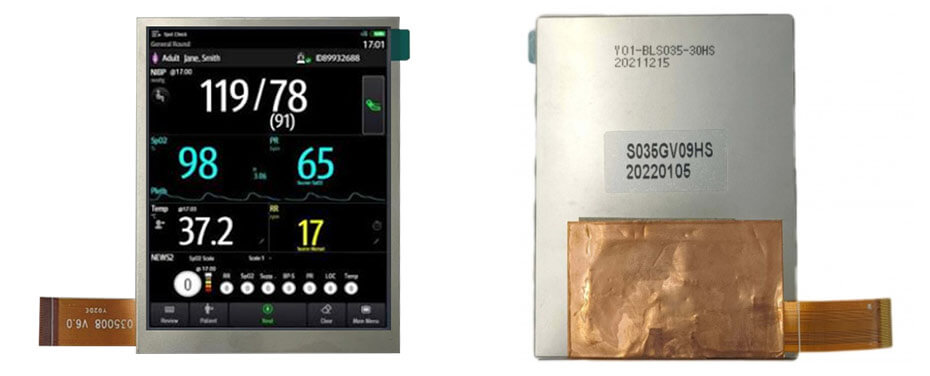
Indoor ward use, no surprises. If the device has to be read from the side or near a window, the 55° upper angle and 500 cd/m² are the two figures to test before committing.
Product page: 12.6 inch AMOLED Display 1620×2560 MIPI
1620×2560 in a 12.6-inch diagonal is a phone-class density scaled up — roughly 240 ppi. That is the kind of panel you put in front of a clinician's eyes at 40 cm, not on a wall: handheld ultrasound, a compact imaging console, a high-end dental or surgical viewer.
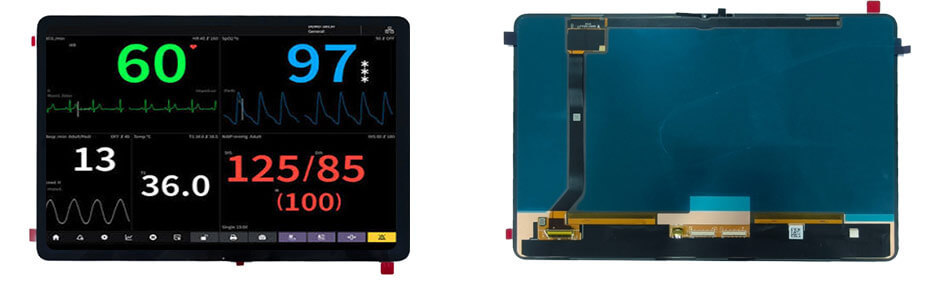
The thin stack and the integrated touch are the reasons to look at it. The reasons to think twice are the ones above: full-screen brightness on a light interface, and what the fixed parts of your UI will look like after two years of daily use.
Product page: 2.7 inch PMOLED Display 128×64 CPU SPI I²C
128×64 monochrome is four lines of text or a row of icons. It is a status display — a mode indicator, a battery gauge, a short numeric reading — and it is very good at that job because almost nothing is lit at idle.
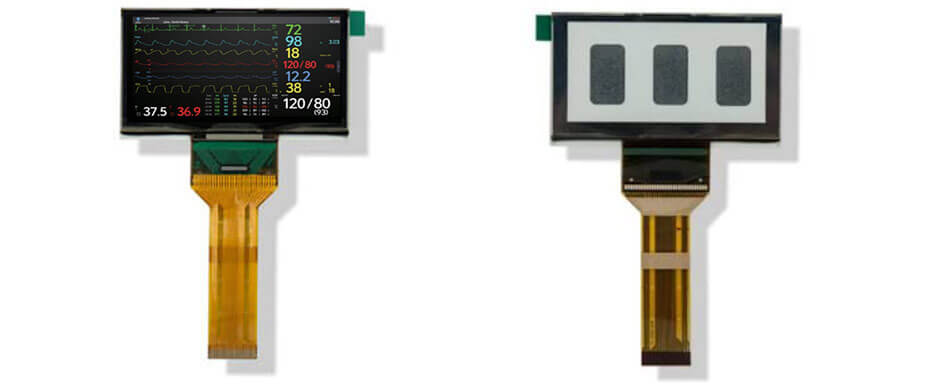
Do not put a waveform on it. On a pump, a meter or a charger, where the screen only ever shows a few icons or a short reading, it is a practical fit — and it draws almost nothing at idle.
The full ranges are here if you want to compare sizes: TFT LCD modules, AMOLED displays and PMOLED displays.
Answer these before you ask for samples, and the technology question usually answers itself. Each one eliminates a branch of the shortlist.
If two answers conflict — say, thin enclosure and all-day static interface — that conflict is the design conversation worth having with the supplier before tooling, not after.
LCD for most of them. It handles continuous operation, light interfaces and daylight brightness more predictably, and it comes in far more sizes. OLED is the better answer when the module must be thin, the interface is dark, or the product needs high resolution in a compact form.
Only on dark content. An OLED showing a white interface with waveforms can draw more than the equivalent LCD, because every pixel is lit. Measure with your actual screen layout at your actual brightness, not with a black test pattern.
Yes, and patient monitors are a high-risk case: fixed labels, fixed waveform grids, fixed alarm areas, running for years. Pixel shifting and compensation help, but on a continuously operating device this belongs in the risk assessment required by ISO 14971 rather than the fine print.
For embedded image displays, previews and controls, yes. For primary diagnostic interpretation, the panel is only one part of a system that has to be characterised and maintained as a whole, and no module datasheet substitutes for that.
AMOLED has a transistor per pixel and handles high resolution and colour. PMOLED drives rows and columns passively, which keeps it cheap and thin but limits it to small panels with few active pixels — 128×64 text and icons, not images.
Yes — TFT LCD, AMOLED and PMOLED, in the sizes and interfaces medical equipment tends to use. If you send the screen size, resolution, interface and mechanical constraints, we can narrow the range down and flag anything that needs a custom build.
Comparing LCD and OLED for a medical device? Send your requirements through our contact page and we will come back with module options for both technologies, including what each one costs you in brightness and lifetime.


