Writer: Nilsson AndersRelease Time: 2026-11-26 07:35Browse: 38
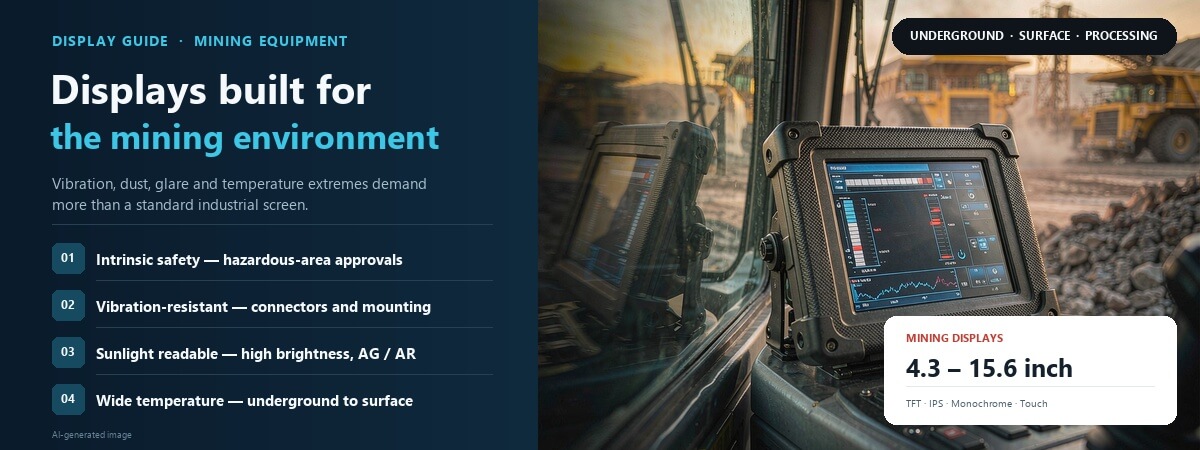
An operator in a haul truck cab reads machine parameters under direct sun; a technician checks fault codes on a panel mounted inside an underground loader; a plant engineer monitors conveyor and crusher status from a processing control room. Three very different installations, one component in common — and a display that survives one may fail in another.
Mining equipment puts screens under continuous vibration, dust, moisture, wide temperature swings and, in some underground applications, hazardous-atmosphere constraints. This guide works through what actually matters when selecting an LCD for mining machinery — electrical safety, environmental protection, mechanical durability, optical performance and mainboard compatibility — so the display fits the complete equipment design rather than just a datasheet. For the fixed-installation counterpart of the same decision, see the guide to HMI displays in automation.
Contents
Mining operations use several types of equipment, each with its own display requirements. Where the screen sits and what it has to report decide the specification before any datasheet is opened.
Drilling machines, continuous miners, roof bolters, loaders and transport vehicles integrate displays into operator stations to present machine status, hydraulic and electrical information, engine and motor parameters, warnings and fault codes, drilling and positioning data, and maintenance diagnostics. Equipment used in potentially explosive atmospheres requires particular attention to electrical safety and applicable mining approvals.
Haul trucks, excavators, wheel loaders, bulldozers and drilling rigs push displays under continuous vehicle vibration, mechanical shock, wide ambient temperature variation, direct sunlight and glare, dust and moisture, and long operating hours. Outdoor readability and mechanical reliability matter most where screens sit in exposed or partially enclosed cabins.
Crushing, screening, conveying and processing systems use displays for monitoring and process control — production data, conveyor status, equipment alarms, sensor readings and process parameters. These applications generally call for larger TFT LCDs, wide viewing angles and compatibility with industrial control systems.
Intrinsic safety is one of the most important considerations for electronic equipment used in certain underground mining applications.
Some underground mines may contain methane, combustible dust or other potentially explosive atmospheres. Electrical equipment in these areas must meet the applicable mine safety and hazardous-location requirements. Intrinsic safety is an explosion-protection concept that limits electrical and thermal energy so a circuit cannot ignite the specified hazardous atmosphere under the conditions covered by its certification.
The applicable protection concept and approval requirements depend on the mine, equipment type, jurisdiction and intended installation location. U.S. underground mining equipment may require evaluation under Mine Safety and Health Administration (MSHA) requirements; other markets use applicable IEC-based explosion-protection frameworks. Guidance on intrinsic safety evaluations applies to powered circuits, assemblies and equipment under specified conditions — a display component by itself should not be treated as an independently approved intrinsically safe product.
A display influences the electrical and thermal characteristics of the complete mining equipment. Relevant factors include LCD operating voltage, backlight power consumption, display controller power, touchscreen controller and interface circuits, connector and cable construction, heat generated during continuous operation, and electrical behavior under normal and fault conditions.
A high-brightness TFT may improve readability but increase backlight power and heat. Under strict intrinsic safety or hazardous-area constraints, these factors must be evaluated as part of the approved electrical system. An ordinary LCD module is not intrinsically safe simply because it runs at low voltage or uses a low-power backlight — the complete equipment or circuit assembly must meet the applicable approval requirements.
These questions should be settled early with the equipment safety engineer and certification body.
Vibration is a major challenge for displays installed in mining machinery. Haul trucks, excavators, drilling rigs and underground loaders run under continuous mechanical movement, and repeated vibration plus sudden shocks affect both modules and their electrical connections.
The risk depends on vibration frequency, acceleration, mounting position, exposure duration and the mechanical design of the complete assembly.
Secure mechanical mounting. Support the display with a structure that prevents excessive movement and stress on the module. Connector reliability. Select connectors and FPC cables for the expected vibration environment, with careful routing and strain relief. Shock protection. The structure may need to absorb sudden impacts and repeated mechanical stress. Touchscreen integration. Evaluate bonding method, cover lens and touch controller connections under the intended vibration conditions.
A module's mechanical specification does not guarantee the durability of the finished machine. Testing should cover the installed display assembly, mounting structure, connectors and cables. Relevant environmental methods include IEC 60068-2-6 for sinusoidal vibration and IEC 60068-2-27 for shock, where appropriate to the equipment test plan.
Mining equipment operates in underground tunnels, outdoor sites, high-altitude locations and regions with extreme seasonal temperatures. A display that performs well in a controlled room may not perform the same way in those conditions.
At low temperatures, LCD response time can increase and visual performance may change: slower pixel response, reduced image transition speed, contrast changes, slower startup and reduced backlight performance. Check the specified operating temperature range rather than relying only on the storage rating.
High ambient temperatures affect the LCD, backlight, driver IC and other electronics. Watch for reduced backlight lifetime, increased internal temperature, contrast shifts, driver circuit reliability and adhesive or material aging. For screens in enclosed cabins or near heat-generating machinery, plan thermal management during mechanical design.
| Application Environment | Display Design Consideration |
|---|---|
| Indoor mining control room | Standard industrial operating temperature may be sufficient |
| Underground machinery | Check temperature range and enclosure conditions |
| Outdoor haul trucks | Evaluate both low- and high-temperature operation |
| Cold-region equipment | Prioritize low-temperature startup and response |
| High-temperature processing areas | Review heat dissipation and backlight performance |
Wide-temperature modules may be necessary in severe ambient conditions, but the final range must be confirmed for the complete assembly — touch panel, controller and bonding materials included.
Operators need to read display information quickly, especially outdoors or in brightly lit cabins. For surface equipment, sunlight readability can be a deciding factor.
Appropriate brightness depends on installation conditions, viewing distance, cover glass and ambient lighting: standard industrial brightness for enclosed cabins, higher brightness for bright operator environments, and sunlight-readable solutions for exposed installations. Brightness should not be considered on its own — a high-brightness LCD is still hard to read if the cover lens creates heavy reflections. The trade-offs are the same ones covered in the high-brightness display guide.
The best approach depends on the viewing environment, cover lens and mechanical structure.
Mining environments expose displays to airborne dust, water spray, mud, oil and other contaminants. Required protection depends on installation location and how the equipment is operated.
Dust enters through gaps around the front panel, connectors and enclosure joints. Consider sealed front-panel construction, suitable cover glass, protected connectors, cable entry sealing and appropriate enclosure design.
Equipment used outdoors or in wet conditions may need protection against rain, spray or washdown. Evaluate the enclosure, sealing structure and front-panel design together. An IP rating applies to the tested enclosure or equipment configuration — a bare LCD module should not be assumed waterproof or dustproof.
Cover lens, surface coating, adhesive and enclosure materials should be checked against the oil, grease, cleaning agents and other substances actually present in the operating environment.
Displays range from simple status indication to detailed graphical monitoring. Size follows viewing distance, available installation space and information load.
| Application | Possible Screen Size | Typical Display Requirements |
|---|---|---|
| Compact machine control panel | 4.3–5 inch | Basic machine status and warnings |
| Mining vehicle operator display | 7–10.1 inch | Machine parameters and operating interface |
| Advanced equipment monitor | 10.1–12.1 inch | Detailed graphical information |
| Processing plant HMI | 12.1–15.6 inch or larger | Process monitoring and control |
These are indicative design ranges, not fixed mining industry standards.
Confirm the display interface before finalizing the mainboard design.
| Interface | Typical Application |
|---|---|
| SPI | Compact display modules |
| RGB | Embedded TFT display systems |
| MIPI DSI | Compact high-resolution displays |
| LVDS | Larger industrial displays |
| eDP | Higher-resolution display systems |
| HDMI | Systems using a compatible LCD controller board |
Other integration parameters include supply voltage and logic levels, connector type and pin assignment, display timing, backlight driver requirements, touch controller interface, firmware and initialization sequence, and cable length and routing. For mining machinery, connector retention and cable protection deserve particular attention because vibration affects electrical connections over time.
Mining machinery and processing systems may run long shifts or around the clock. Select for long-term operation, not just initial image quality.
Interpret backlight lifetime against the manufacturer's stated test conditions — actual service life varies with brightness settings, ambient temperature and operating conditions. For OEM projects, revision control matters too: swapping in a different display module can affect mechanical design, electrical interface, firmware and certification documentation.
| Challenge | Recommended Consideration |
|---|---|
| Display intermittently disconnects | Review connector retention, FPC routing and strain relief |
| Image hard to read outdoors | Evaluate brightness, AR treatment and optical bonding |
| Slow response in cold conditions | Check LCD operating temperature specifications |
| Display overheats inside enclosure | Review backlight power and thermal management |
| Screen damage from vibration | Evaluate mounting structure and assembly testing |
| Dust or water enters the equipment | Review front-panel sealing and enclosure IP rating |
| Display does not match the mainboard | Confirm interface, voltage, timing and connector |
| Certification process becomes complicated | Involve safety and certification engineers early |
Most integration problems can be reduced by defining the operating environment and display requirements before mechanical and electrical designs are finalized.
Application and safety
Optical performance
Mechanical performance
Environmental performance
Electrical integration
Defining these requirements early helps manufacturers select a suitable display and reduce engineering changes during product development.
Youritech provides industrial LCD and touch display solutions for embedded equipment manufacturers. Mining display requirements vary significantly with equipment type, installation location, operating environment and system architecture.
Potential customization considerations include:
Whether the application is an underground mining machine, a surface haul truck or a mineral processing control panel, display selection should be coordinated with the mainboard, enclosure and equipment safety requirements.
Looking for an industrial display for mining equipment? Contact Youritech to discuss screen size, brightness, operating temperature, interface and customization requirements.
Request a Quote / Get a Custom Display Solution
It depends on the application. Mining vehicle operator stations may use rugged TFT LCD modules, while compact machine controllers use smaller TFT or monochrome LCDs. Operating temperature, vibration, sunlight readability and equipment safety requirements should all be considered.
No. A low-voltage or low-power LCD module is not automatically intrinsically safe. Intrinsic safety must be evaluated as part of the complete electrical circuit or equipment assembly under the applicable approval requirements.
Mining equipment experiences continuous vibration and mechanical shock, which affect connectors, FPC cables, solder joints and mounting structures. Mechanical design and complete assembly testing are therefore important.
There is no single requirement for all mining equipment. It depends on underground or surface installation, regional climate, enclosure temperature and operating conditions. Specify both minimum and maximum operating temperatures.
Displays in outdoor mining vehicles may need more brightness than those in enclosed control rooms. Actual requirements depend on ambient light, viewing angle, cover glass and surface treatment.
An IP rating must be checked against the tested product configuration. A bare LCD module should not be assumed waterproof or dustproof — the complete enclosure and front-panel sealing must provide the required protection.
Yes. Screen size, resolution, brightness, operating temperature, interfaces, connectors and touch integration can be discussed against the equipment manufacturer's project requirements.
Mining displays are asked to stay readable and connected under vibration, dust, moisture, sunlight and temperature extremes, while fitting into equipment that may face hazardous-area approval. Start with the application and environment, then work through safety, mechanics, optics and interfaces as one system. Define those requirements early and the display becomes a reliable part of the machine instead of a late-stage engineering problem.
Youritech — Industrial LCD and Touch Display Solutions for Embedded Applications.


